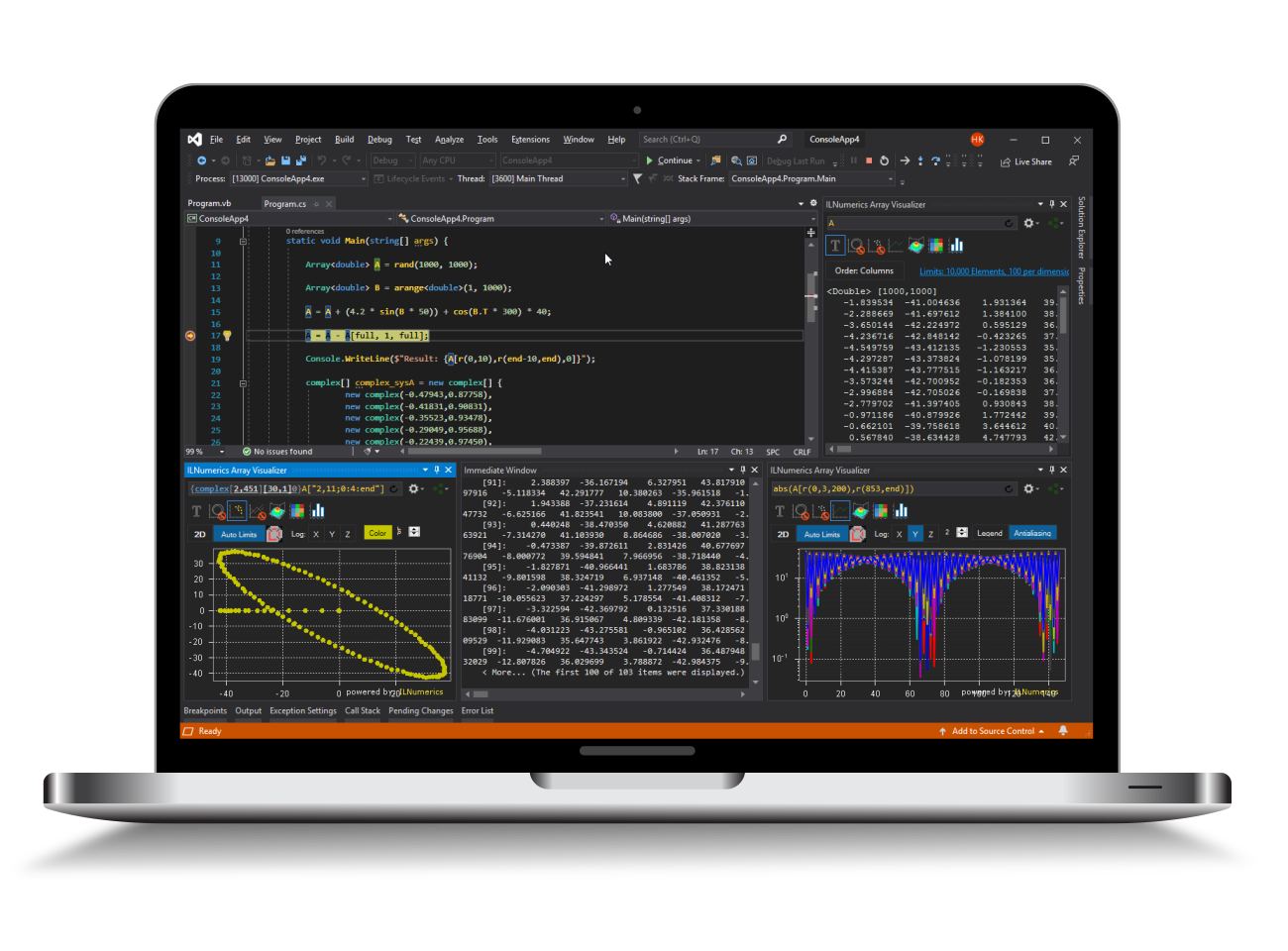
ILNumerics Accelerator – Demos & Benchmarks
Explore reproducible benchmarks, demos, and technical articles for ILNumerics Accelerator. The material shows how high-level .NET array code is transformed into autonomous, dependency-safe, massively parallel execution — and how to verify the results on your own hardware.
The benchmark artifacts are designed to demonstrate both performance and correctness. They cover how to verify accelerated code, measure speedups, configure acceleration, and interpret benchmark results across different workloads and hardware configurations.
Featured benchmarks and articles
- Speed comparison: low-level expressions: compares NumPy, Numba, Fortran, and ILNumerics for the expression
$sum((m0 & (A << shift)) | (~m0 & B), dim: 1)$. - Getting Started, Part I: investigates acceleration for a simple reduction operation.
- Getting Started, Part II: examines optimizations applied to a larger function context using k-means clustering.
- Getting Started, Part III: compares large FFT batches with Intel MKL in the measured scenario.
- Getting Started, Part IV: explains array instruction parallelism and compares it with traditional manual parallelization approaches.
Reproducible benchmark repository
The ILNumerics/decentralized-array-execution-artifacts2026 repository hosts the benchmark artifacts used for the 2026 paper, “A Virtual Processor brings back the Free Lunch” (PDF). The repository is designed for reproducible local runs, so teams can evaluate the benchmarks on their own hardware and compare results.
Benchmark results depend on workload, data size, hardware, runtime configuration, and implementation details. The purpose of the repository is to make these factors transparent and to give developers a practical way to reproduce the measurements.
What to look for
- Correctness checks between baseline and accelerated execution
- Speedup measurements for realistic array workloads
- Effects of data size, memory layout, and hardware configuration
- Comparison with manual parallelization and native numerical runtimes
- Examples of autonomous array instruction parallelism in practice